
(CNSNews.com) – Jonathan Winer, the Obama administration’s special envoy for Libya, told members of Congress that the State Department wants to reopen the shuttered U.S. embassy in Libya.
“We very much want to have our embassy reopened in Libya,” Winer said during a Senate Foreign Relations Committee hearing in Washington on Wednesday. “That’s a policy goal. We want to be present in Libya. We think it’s important that we’re present in Libya.
“Our ability to do that depends on our evaluation of the security situation. And as of now, we have not evaluated that it’s time for us to do that”, despite what he called the “relative stability and calm in Tripoli,” Winer added, noting that the administration is requesting an additional $20.5 million for assistance to Libya.
Since the fall of Muammar Gaddafi’s regime in 2011, Libya has been “further damaged by infighting among contenders for political power,” the special envoy said in his opening statement.
The U.S. closed its embassy in Tripoli on July 26, 2014 after evacuating about 150 personnel due to escalating violence in a civil war that broke out earlier that year, with both sides claiming to be the country’s legitimate government.
“With no monopoly of control of security by a state, terrorist and criminal groups established a presence in various areas in Libya,” Winer testified.
“It was in response to that political crisis that the United States worked with other countries to support the UN Mission in Libya in the negotiation of the Libyan Political Agreement in Skhirat, Morocco which brought about the GNA (Government of National Accord) on December 17, 2015,” Winer added.
The U.S. has “offered its unequivocal support to the GNA…as it combats Da’esh [ISIS] and other violent extremist groups in Libya.”
Ranking Member Ben Cardin (D-MD) asked Winer what specific security measures needed to be taken to reopen the embassy.
“Diplomatic security is [going to] have to feel that it’s the right thing to do in the first instance. Other parts of the administration would have to concur,” Winer replied.
Chairman Bob Corker (R-TN) asked Winer whether he believed Libya could be put back together as a unified state despite the chaos of the past few years and the presence of ISIS.
“A unitary state for Libya is absolutely essential,” Winer responded. “Any division of Libya … would be disastrous for the people of Libya, for the country, for the region and bad across the board”.
“At the center of our policy has been support of the creation of the GNA as a unifying bridge to help Libyans move beyond the damaging period of political competition, referred to by the chairman and ranking member, and fragmentation until the country adopts a new constitution and a long-term government,” Winer said in his opening statement.
Gen. David Rodriguez, commander of U.S. African Command, said during a Pentagon briefing in April that about 4,000 to 6,000 ISIS fighters were present in Libya.
“Libya’s porous borders, and political and security vacuum have allowed Daesh to plan and carry out significant attacks in Tunisia and Libya,” Winer stated. However, he pointed out that the terror group has recently been losing ground, as exemplified by the GNA’s recapture of Derna Province.
“We’ve seen Libyan forces, aligned with the GNA, engage in sustained fighting against Daesh in the region around [the central coastal town of] Sirte and entering into the city. They have made impressive gains against a ruthless enemy,” Winer testified.
“The GNA… has established command centers to combat Daesh in Sirte. Prime Minister Fayez al-Sarraj has stated he would seek international assistance to train and equip GNA forces for this fight, which will not be a fight that will be merely over in days or weeks,” he noted.
Sen. David Perdue (R-GA) pointed out Libya’s precarious financial status.
“Oil is right now almost all, almost 97 percent of their revenue, and I know with the price of oil being down, and also their annual production is about a third of their capacity, if I got the numbers right, and then I look at the reserves… depending on the amount of outtake they have every year, could be short-lived as three to nine years,” Perdue said.
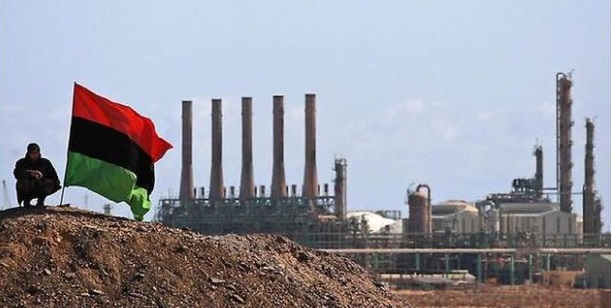
“They are at risk of eating up all their seed corn and being left with a disaster if they don’t get their acts together to pump their oil,” agreed Winer. “We’re working right now to try and get [Commander of Petroleum Defense Guards] Ibrahim Jadhran and his national petroleum forces to turn the oil back on in the oil crescent.”
The Heritage Foundation’s 2016 Index of Economic Freedomstated that oil and natural gas provide about 80 percent of Libya’s GDP, 95 percent of its export revenues, and 99 percent of its government revenues.
Winer added that the Libyans should be pumping about 1.5 billion barrels a day rather than the 350,000 barrels a day they produced last year. He attributed some of the loss of production to ISIS’ destruction of oil terminals used for storage.